Measure twice, cut once: how a heritage jewellery house sold online for the first time
- Industry
- Heritage jewellery, Taiwan
- Built
- Multilingual storefront
- Services
- Store research, design, development, training
At a glance
12-week project from kick-off to handover
Quoted 50% less time to deliver than other pitches
200 unique SKUs
Founded in 1932 in Kaohsiung, Taiwan, Jadegia (玉世家) is a heritage jewellery house with stores in some of Taiwan's most exclusive retail destinations, including Taipei 101.
Over three generations, Jadegia built a reputation among high-end jade collectors, both locally and internationally. Yet its online presence remained a decade-old brochure website, with no e-commerce functionality or meaningful analytics.


Jadegia had always sold through its physical stores, building personal relationships with customers through face-to-face service and private consultations.
This approach limited growth, international customers accounted for up to 50% of sales in some stores, yet making another purchase from overseas was difficult.
Jadegia needed a new sales channel without compromising the personal experience and brand reputation it had spent decades building.
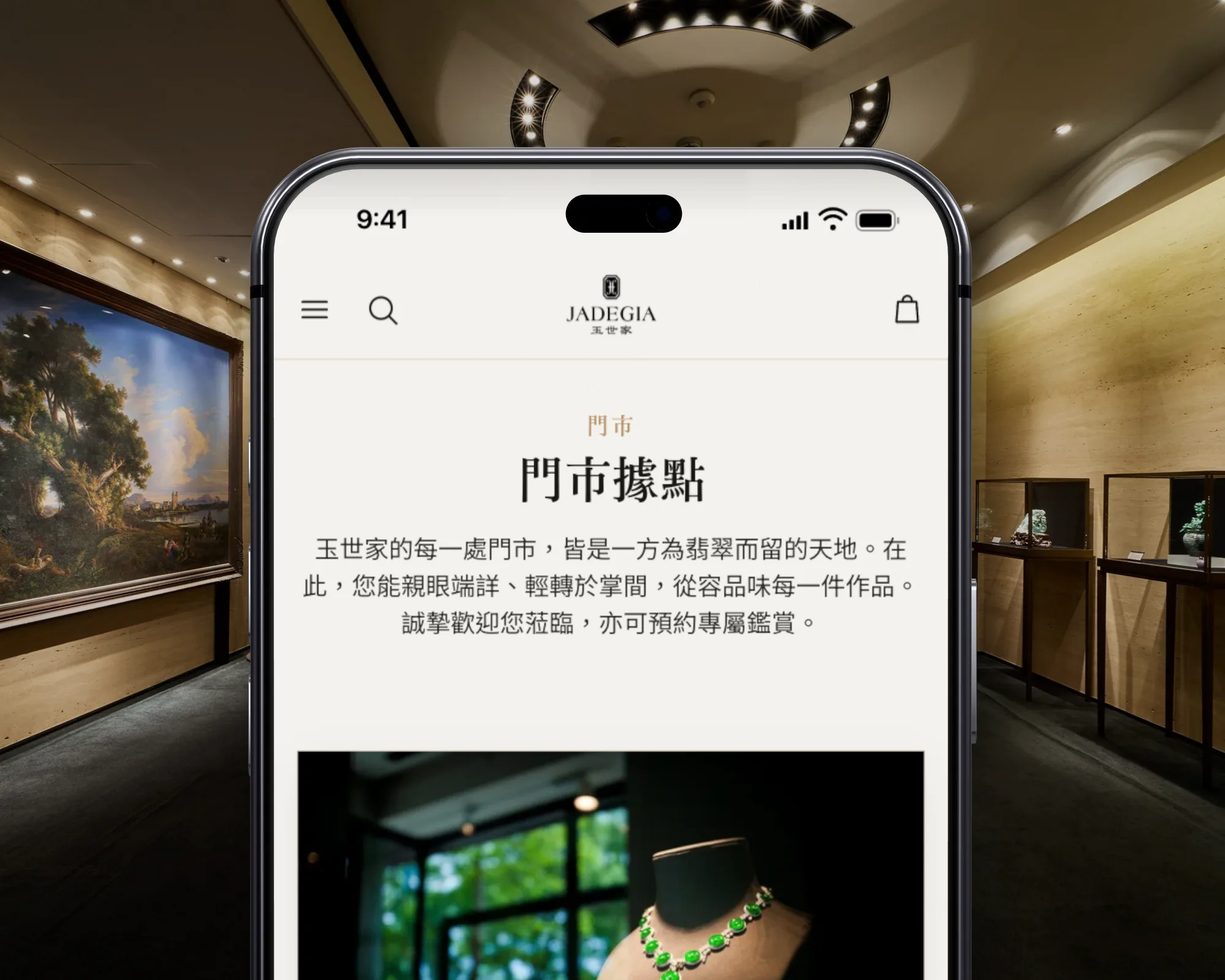
For growth, they had to move their sales channel online while retaining their in-store experience. Jadegia approached hurulab to help them achieve their goals.
A bricks-and-mortar approach
The new website needed to feel like an extension of Jadegia's stores, this was the most logical start point. Our team visited its flagship and retail stores, met with sales teams, and understood the customer experience through the lens of digital design. Our team photographed store interiors and signage to product displays, packaging and marketing materials, translating these physical elements into a library of reusable digital assets.

This library allowed us to produce multiple iterations of components to be applied and rearranged across designs, pages and user flows, giving Jadegia the freedom to explore options and make decisions without lengthy design cycles.
Early on, hurulab and Jadegia agreed to favour established services over custom engineering unless there was a compelling reason otherwise. Shopify was chosen to minimise complexity, cost and delivery risk.
The two-ways-to-buy approach was extra logic, any product worth over a threshold amount, the user was directed towards a consultancy meeting, via social media, the most used channels for its customer base.
Rather than creating static, high-fidelity mockups, hurulab deployed working designs directly to Shopify. Within days, Jadegia could experience the platform and review changes through interactive prototypes.

Using hurulab's AI-assisted design process, combining creativity, design principles and engineering, the team shortened the distance between ideas and working experiences.
By putting usable designs in front of people who understood the business and its customers, hurulab could gather feedback early fast-tracking decision making from Jadegia on what needs keeping, or changing.
In 12 weeks, Jadegia went from a dated, brochure-style website to a multilingual e-commerce storefront, introducing the new sales channel without disrupting the in-store relationships for its higher end pieces.
The new site offered a more contemporary digital experience aligned with Jadegia's brand, with streamlined product browsing, checkout and content management.
Social media traffic could now be tracked through to purchase, giving Jadegia visibility into campaign performance and a better basis for decisions about marketing spend.
Beyond the storefront, hurulab delivered a tailored e-commerce system built on Shopify, combining custom apps and integrations. The team also trained store managers in order processing, fulfillment and refunds, providing bilingual guides to support day-to-day operations.
The project reinforced three lessons
- 01
Understand, then design.
Directly connecting first-hand research with reusable design assets made iterations faster and more focused.
- 02
Build to test, not just present.
Working directly in Shopify eliminated a separate high-fidelity design phase and gave engineers a head start with existing code.
- 03
Keep complexity where it adds value.
Using established services reduced unnecessary engineering and helped keep delivery on track. Custom work was spent only when all other options weren't up to the job.
Momentum is where Jadegia benefited as we made decision making simpler. Store-inspired designs gave familiarity. Directly building these designs on a usable platform made it real.
MoreHarvest
Prototypes showed MoreHarvest what earns investors' trust. Then AI took four codebases to two, in months.